
Wedding Photographer Vienna: A Destination Wedding Guide
A wedding photographer Vienna couples hire from Stockholm brings a Nordic documentary eye to one of Europe’s most architectural cities. Vienna is unlike any other city wedding destination in Europe. The grand palaces, the baroque ballrooms, the quiet cobblestone courtyards hidden behind 18th-century facades. It feels like stepping into a setting where elegance is the baseline, not something that needs to be engineered.
I am a wedding photographer based in Stockholm and have photographed destination weddings across Europe. Vienna holds a particular place in my portfolio because of the way the city layers history and everyday life. This page covers what it actually takes to plan a Vienna wedding: venues, legal requirements, logistics, the best seasons, and the details that make the difference between a smooth destination wedding and a stressful one.
If you are comparing European destinations more broadly, the best wedding venues in Europe guide sets Vienna in context with Italy, Greece, and the Nordics.
IN SHORT
This is a guide to a wedding in Vienna, Austria, photographed by a Stockholm-based documentary photographer. Vienna International Airport has direct flights from most European capitals, and only civil marriages are legally binding there. The guide covers the city as a wedding setting, the legal steps and how a Nordic photographer works there.
Updated: July 2026
QUICK FACTS
Country: Austria
Airport: Vienna International (VIE), direct flights from most European capitals
Legal civil ceremonies: Only civil marriages are legally binding; religious ceremonies may follow
Filing office for foreigners: Standesamt Wien-Innere Stadt, Schlesingerplatz 4, 1082 Vienna
Best seasons: May-June, September-early October, plus a small window in late December for winter weddings
Typical booking window: 12-18 months ahead for peak dates
Venue types: palais, historic hotels, baroque gardens, Vienna Woods estates, Wachau Valley wineries
Official tourism: wien.info
Why Vienna works for a destination wedding
Vienna consistently ranks among the most livable cities in the world and has the infrastructure and hotel capacity to host international guests comfortably. For a wedding, that matters practically: flights from most European capitals land directly at Vienna International, the city centre is compact enough to walk, and the public transport works so well that guests rarely need a car.
Aesthetically, Vienna offers something specific: a layered Habsburg-era backdrop that is still a living city rather than a film set. You can have a ceremony in a baroque palais, a dinner at a historic hotel, and a late walk through the Innere Stadt, and all three locations are within a short drive of each other. Most destinations make you choose between architecture and ease. Vienna gives you both.
Vienna also has a food and coffee culture that shapes the day. A mid-afternoon coffee break at a traditional Viennese cafe (Cafe Central, Cafe Sacher, Cafe Hawelka) is not a tourist detour; it is part of how the city actually works. Built into a wedding timeline, it becomes one of the calmer moments of the day.
This guide is written by me, Karin Lundin, a wedding photographer based in Stockholm. Further down the page I share what it is like to photograph here. Planning a wedding and want to talk? Get in touch and we will talk.
Vienna wedding venues by type
Palais venues
Vienna’s palais buildings are former aristocratic residences that have been converted into event venues. They range from fully restored baroque interiors to more minimal spaces within historic shells. Common choices include Palais Coburg, Palais Liechtenstein, Palais Pallavicini, and Palais Daun-Kinsky. Capacities typically run from 60 to 250 guests depending on the space, and most have in-house or preferred catering partners that know how to run a full wedding day.
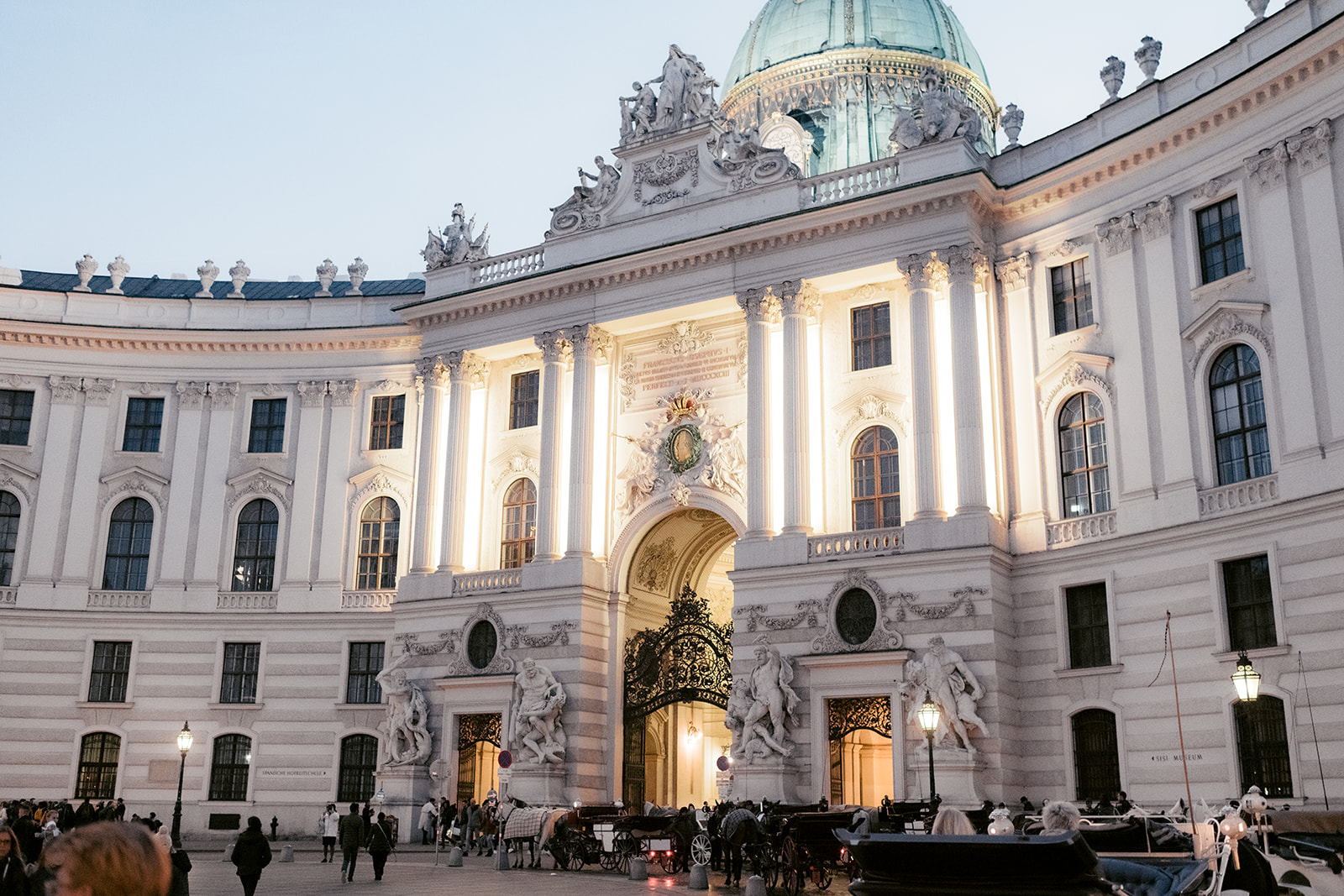
For photography, palais venues give you decorative ceilings, mirrored halls, grand staircases, and the kind of natural light that comes through tall windows in the afternoon. You rarely need to leave the building for portraits. That matters when the timeline is tight or the weather turns.
Historic hotels
Vienna has a concentration of heritage hotels that take weddings regularly: Hotel Sacher, Grand Hotel Wien, Hotel Imperial, Hotel Bristol, Park Hyatt Vienna. These work well for couples who want accommodation, ceremony, and reception in one building, particularly for smaller weddings of 40 to 100 guests. The advantage is continuity: the day starts and ends under the same roof, and out-of-town guests can walk to their rooms after dessert.
Gardens and parks
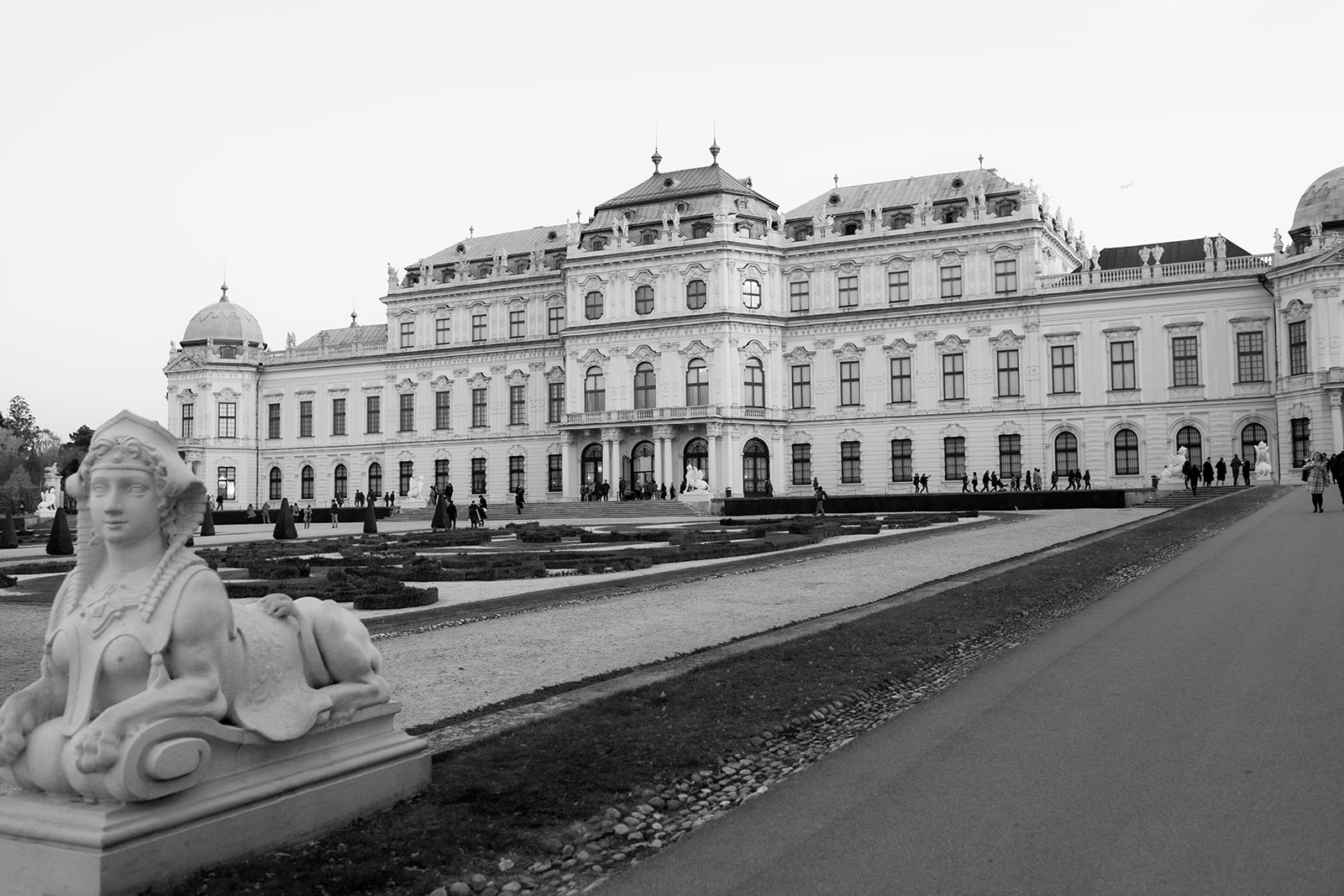
Vienna’s parks are a destination in themselves. Popular options for ceremonies, elopements, or post-ceremony portraits include the gardens of Belvedere, the Volksgarten with its rose gardens and classical temple, the grounds of Schoenbrunn Palace, and the Prater park with its giant Ferris wheel on the horizon. These work particularly well for elopements and smaller ceremonies.
Outside the city: Wachau Valley and Vienna Woods
The Wachau Valley along the Danube is about an hour west of Vienna and a UNESCO World Heritage site. Vineyards, medieval villages, hilltop ruins, and the river running through the middle of it all. Several estates and wineries along the Wachau host weddings and work well for couples who want the baroque city backdrop without staying in it the whole weekend. Common anchor villages: Duernstein, Weissenkirchen, Krems.
The Vienna Woods (Wienerwald) on the western edge of the city offer a different kind of setting: forest, small estates, and wine taverns (Heurigen) that have been pouring the same white wine for centuries. Good for rehearsal dinners, day-after gatherings, or a more rustic ceremony within 30 to 45 minutes of the city centre.
Photographing a wedding in Vienna

My name is Karin Lundin and I am a wedding photographer based in Stockholm. I travel throughout Europe for weddings and Vienna is one of my favourite cities to return to, mostly because of how easy the backgrounds are. The city does a lot of the work for you.
My style is observational and close to the couple rather than staged. I focus on real moments, natural light, and the kind of photographs you want to look at more than once. In Vienna that approach suits the city: the architecture becomes backdrop rather than subject, and the day unfolds naturally because there is always another frame within a few steps.
A few practical notes from photographing here. First, light in palais buildings changes fast because of the tall windows and the ornate ceilings. I shoot manual most of the day at these venues and keep a second body ready for low light in the inner rooms. Second, the city is compact but the logistics between venue types (ceremony at a palais, portraits at a nearby park, dinner at a hotel) work only if you plan transfers properly. A good local planner solves this before it becomes a problem.
Third, Vienna has a golden hour that works in your favour year-round. Summer evenings stay light until around 21:00, autumn gives you richer amber tones from late September, and winter blue hour arrives early (around 16:30 in December) and lasts long enough to use for portraits. Each season shapes the day differently.
Want to capture the day on film as well? I often work alongside Nordver Films, who film weddings with the same quiet attention to light and moment. If you want to see how I work, there is a separate page about fine art wedding photography in Sweden.
Practical information for a Vienna wedding
Getting there
Vienna International Airport (VIE) sits 18 km southeast of the city centre. The CAT (City Airport Train) runs every 30 minutes and takes 16 minutes to reach Wien Mitte station. Taxis or private transfers run 30-45 minutes depending on traffic. Direct flights from Stockholm are roughly 2 hours 30 minutes and run daily year-round.
Within the city, U-Bahn (metro) and tram cover almost everything guests need. Most palais and hotel venues are within walking distance of each other in the Innere Stadt. For the Wachau Valley or Vienna Woods, plan private transport or charter a small bus if moving a full wedding party.
Best seasons for a Vienna wedding
- May-June: long days, gardens in full bloom, warm but not hot. Peak wedding season, so venues book early.
- September-early October: warm days, cooler evenings, autumn light starting. Fewer tourists than summer.
- Late October-November: quiet and atmospheric. Rain can be unpredictable.
- December: a small winter wedding window. Christmas markets, snow often but not guaranteed. Good for intimate elopements.
- January-March: cold and often grey. Skip unless you want a specific winter ceremony look.
- April: spring arrives late. Last-week-of-April dates are workable but weather-dependent.


Legal requirements for getting married in Austria
Only civil marriages are legally binding in Austria. Religious ceremonies can follow but do not carry legal weight on their own. For foreign couples, the process runs through the Standesamt (registry office), and couples who are neither Austrian nor resident in Austria file through Standesamt Wien-Innere Stadt at Schlesingerplatz 4 in central Vienna.
The core document set typically includes: a valid passport, a birth certificate, proof of citizenship or entry in the Central Citizenship Register, and proof of main residence where applicable. If either partner has been previously married, a divorce certificate or proof of annulment needs to be submitted. The registry may request additional documents depending on your country of origin.
The application can be filed up to six months before the wedding date. In larger cities like Vienna, the waiting time between registration and ceremony is typically two to six weeks, so plan the paperwork early. If one or both partners do not speak German, an official Austrian interpreter must attend the ceremony, with typical fees up to around 500 EUR.
Many international couples handle the legal civil ceremony in their home country before travelling to Vienna and have a symbolic ceremony at the venue instead. That removes the German-language and document-timeline requirements entirely. A local planner can tell you which route makes most sense for your nationalities and dates.
Vienna wedding venues at a glance
| Venue type | Capacity | Best for |
|---|---|---|
| Baroque palace (e.g. Palais Coburg, Palais Pallavicini) | 80 to 200 seated | Formal weddings with classical music, grand architecture |
| Schönbrunn Orangery / Schloss Schönbrunn | Up to 300 | Larger receptions, imperial setting, garden access |
| Boutique hotel (Sacher, Park Hyatt, Rosewood) | 40 to 120 | Intimate weddings with full-service hospitality |
| Vineyard / Heurigen (Vienna outskirts) | 30 to 100 | Relaxed celebrations with Austrian character |
Seasons for a Vienna wedding
May and June bring the most reliable weather, long evenings and full access to gardens at Schönbrunn and Belvedere. The spring light lingers past 21:00 and gives the baroque facades a warm glow.
September and early October are the photographer’s favourites. Temperatures settle into 18 to 24 °C, gardens take on autumn tones, the tourist peak has passed, and the light quality through October is especially strong for portraits in the courtyard settings Vienna is known for.
December is worth considering for couples drawn to winter weddings. Advent markets, candlelit palace ballrooms and snow across the Ringstraße create a very different atmosphere. Vienna in winter is cold, but the indoor venues are built for it.
Practical note for Swedish couples: Vienna is 2 hours 30 minutes direct from Stockholm Arlanda with multiple daily flights. Most wedding planners in Vienna speak fluent English, and legal civil ceremonies at the Vienna Standesamt require paperwork submitted 3 to 8 weeks in advance depending on nationality.
Vienna sits in a useful spot for Nordic destination weddings. The flight from Stockholm is short enough that a Friday-Sunday wedding works without anyone losing two extra days to travel. The city’s hospitality infrastructure is built for an international clientele. Most planners speak fluent English, hotels handle multilingual guest blocks routinely, and venues are used to coordinating with photographers and florists from outside Austria. For couples weighing Vienna against Tuscany or Amalfi, the practical case is strong: same-day travel from Stockholm, lower per-guest cost than coastal Italy, and architecture that few Mediterranean venues can match.
A final note on pace: Vienna rewards couples who let the day breathe. The city’s rhythm is slower than Stockholm, dinner runs longer, the receptions stretch, and the baroque settings look their best when the couple and guests aren’t rushed through them. Build a timeline that gives each programme item an extra 15 to 20 minutes more than you would at home. It is one of the small planning decisions that makes Vienna weddings feel different, and it shows in the photographs.
Considering this venue for your wedding? I have photographed here several times and would love to share what I have seen work well. Get in touch and we will take it from there.
Key takeaways
- Vienna works for weddings between 40 and 250 guests, with palais and historic hotels covering most needs.
- Direct flights from Stockholm and most European capitals land at Vienna International (VIE) in under 3 hours.
- Civil marriages are the only legally binding form in Austria. Foreign couples file through Standesamt Wien-Innere Stadt.
- Best months: May-June for peak bloom, September-early October for autumn light, December for winter elopements.
- Many couples handle the legal ceremony at home and have a symbolic one in Vienna, which avoids German interpreter requirements.
- Book venues 12 to 18 months ahead for peak dates. Line up photographer, planner, videographer, and florist soon after.
Frequently asked questions about a Vienna wedding
Do we need to speak German to get married in Vienna?
For the legal civil ceremony at the Austrian Standesamt, yes: if one or both of you do not speak German, an official Austrian interpreter must attend the ceremony. Interpreter fees can run up to around 500 EUR. Many couples sidestep this by doing the legal ceremony in their home country and having a symbolic ceremony at the Vienna venue, which can be conducted in any language.
How many guests can a Vienna wedding hold?
It depends on venue type. Palais venues range from 60 to 250 guests. Historic hotels typically seat 40 to 150. Heuriger (wine tavern) receptions in the Vienna Woods work for 30 to 80. For elopements, 2 to 20 is the usual range.
When is the best time of year for a Vienna wedding?
May and June for peak bloom and long evenings. September and early October for autumn light and fewer tourists. December for winter elopements and Christmas-market atmosphere. January-March is cold and usually grey, April arrives late. Mid-May and mid-September are the safest weather windows.
How far in advance should we book?
For peak dates, 12 to 18 months. Palais at the top end of the market book particularly early. Off-peak dates can sometimes be secured in 6 to 9 months but core suppliers (photographer, videographer, planner) should be confirmed 9 to 12 months out regardless.
Do we need a local wedding planner?
For most Vienna weddings, yes. A local planner handles venue coordination, legal paperwork if doing the civil ceremony locally, German-language logistics with suppliers, and the timeline across multiple locations.
More destination weddings
Looking at other destinations? See the Italy guide, the Casa Privata on the Amalfi Coast, the Greece guide, the Lesante Cape Zakynthos guide, or the best wedding venues in Europe overview.
Planning a wedding? I am happy to talk about how your day could look in pictures. Get in touch and we will talk.