
First look wedding: pros and cons seen from behind the camera
IN SHORT
A first look wedding means the two of you see each other for the first time that day before the ceremony, in a planned and private moment with the photographer present. The main reason to choose it is that the portraits can then be taken before the ceremony, which gives you around 45 more minutes with your guests afterwards. Late in the season it is often the only way to get portraits in daylight, since the sun sets at 15:11 in Stockholm on 21 November.
QUICK FACTS
What: A planned meeting where you see each other before the ceremony, with the photographer present
When in the timeline: A little over an hour before the ceremony, in a typical schedule 13:45 for a ceremony at 15:00
Time needed: Around 15 minutes for the meeting itself, about 45 minutes including portraits and photos of the wedding party
Suits: Couples who want time with their guests, weddings late in the season, large guest lists
Alternative: Seeing each other first at the altar and taking the portraits after the ceremony
A first look wedding is a wedding where the couple meets in a planned moment before the ceremony, with the photographer present, and the strongest reason to choose one is that the portraits can then be taken before the ceremony. The choice shapes the whole day. It decides when the portraits happen and how much time you get with your guests, and it affects how you feel in the hours before you walk in to get married. No single answer suits every couple, and this guide gives you what you need to choose with open eyes.
The guide covers what a first look is and how it plays out, what it does to the schedule, the advantages and drawbacks you notice on the day, and the situations where it fits well or poorly. Everything here builds on experience from real weddings in and around Stockholm. Couples who travel to Sweden to marry will also find notes on the Nordic light, which changes faster through the autumn than many visitors expect.
If you want to see how the whole day fits together, from hair and makeup in the morning to the evening portraits, there is a separate guide to the wedding day timeline. This post goes deeper into the single decision about a first look and leaves the rest of the schedule to that guide.

What is a first look and how does it work?
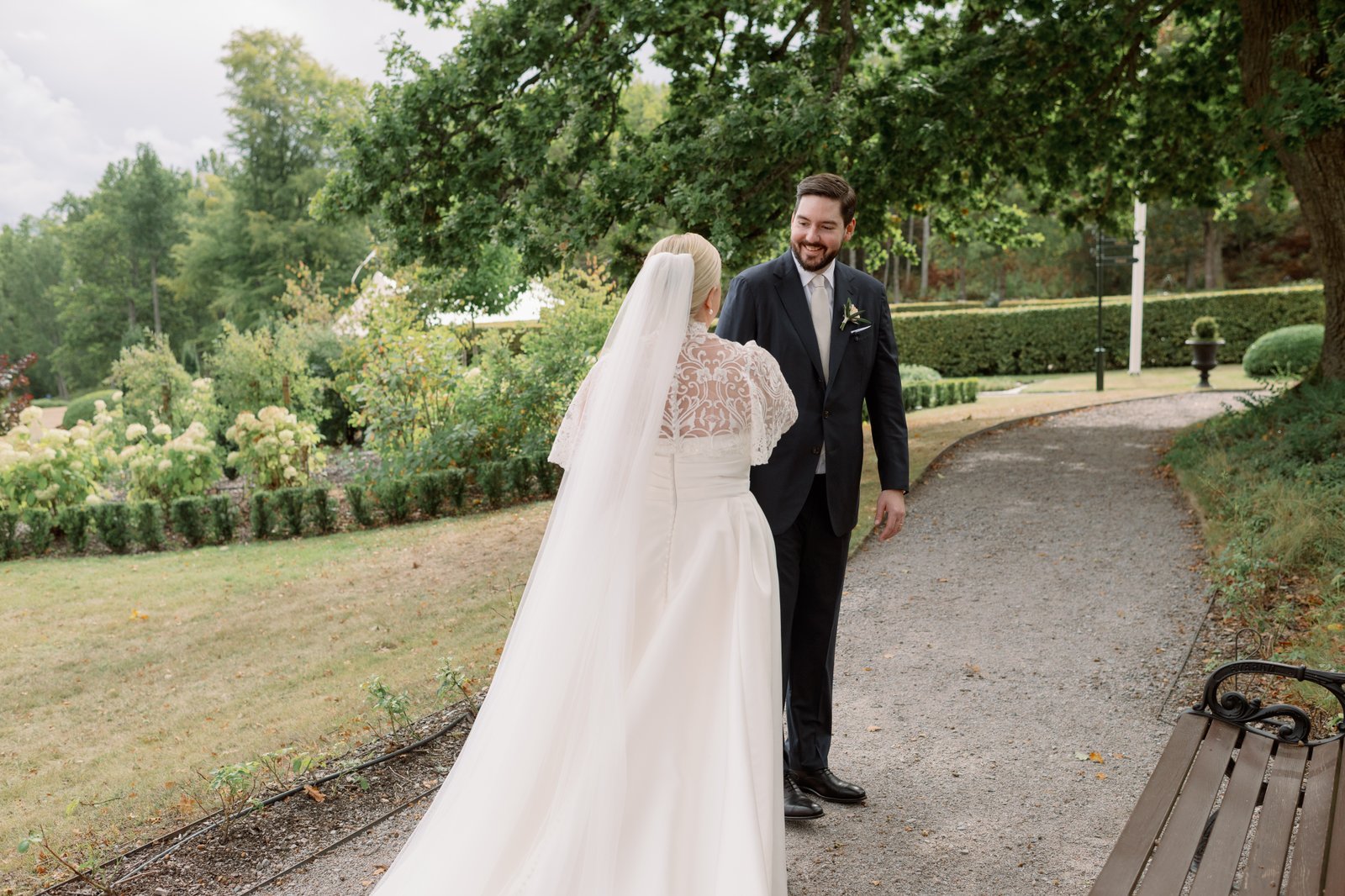
A first look is an arranged meeting before the ceremony. You get ready in separate places during the morning, and you meet in a calm spot chosen in advance before anyone else sees you together. The most common setup has one of you standing with their back turned while the other walks up, and then you turn to face each other. The photographer stays a short distance away and documents the moment, stepping in only as much as needed.
The meeting itself usually takes around a quarter of an hour. Couples react in their own way, from laughter and a straightened collar to long silences. Some read letters they have written to each other, since this is one of the few moments of the day when you are alone together. There is no template for how it should feel. That is what makes the moment work in pictures, because the reaction belongs to you, with no hundred people watching.
Straight after the meeting the portraits usually follow, while hair and makeup are fresh and you have settled into your clothes. Photos of the wedding party often go into the same block. How the pictures look after that depends on how your photographer works. I work in a documentary way, which means I follow what happens and capture it as it unfolds.
A first look is planned in the sense that the place and the time are agreed beforehand. What happens once you turn around is yours. The photographer sets the frame and then lets the two of you fill it, which is why the meeting tends to look calm and personal in the final gallery.
How does a first look change the wedding day timeline?
This is the core of the decision. The portraits have to be taken at some point during the day, and the question is where in the schedule they sit. With a first look they come before the ceremony. Without one they come afterwards, in the block between the ceremony and dinner, where they share the time with congratulations and group photos before the reception with your guests.
TIMELINE WITH A FIRST LOOK
13:45 First look, portraits and photos of the wedding party
14:30 A pause before the ceremony
15:00 Ceremony
15:40 Rice throwing and congratulations
16:00 Group photos, about 30 minutes
16:30 A short supplementary portrait session
17:00 The couple joins the reception
This is my standard schedule when a couple has chosen a first look. Times are written in the 24-hour format used in Sweden. Look at what happens after the ceremony. The congratulations get a block of a quarter of an hour, the group photos half an hour, and by 17:00 the couple is out among the guests with a glass in hand. That works because most of the portraits were taken before the ceremony.
Without a first look, the same portrait time has to sit after the ceremony. That works well too, and many of my weddings are planned that way. The block between ceremony and dinner then grows by around three quarters of an hour, and that time comes out of the reception. If the venue has its good portrait spots a short walk away, add walking time in both directions on top.
So the choice moves your time with your guests around the day, and the quality of the portraits stays the same either way. Counting backwards from dinner is the quickest way to see how much room your afternoon has. Write the dinner time at the bottom of a page, subtract the reception you want, and the space left for portraits appears on its own.
What do you gain with a first look?
The first gain is calm. For many couples the hours before a ceremony are the most nervous of the whole day, and much of that tension is about seeing each other. Once that meeting has happened, something lets go. Couples who have done a first look often walk in to their ceremony with lowered shoulders, present in the room and ready for it.
The second gain is time, as the schedule above shows. The portraits are done before the guests have even arrived, and once the congratulations are over, only the group photos and a short supplementary session remain. The rest of the afternoon belongs to you. For couples with large guest lists this is often the whole reason, since with a hundred guests who all want to hug you the reception barely covers it anyway.
The third gain is light, and it grows in weight the later in the year you marry. A first look early in the afternoon means the portraits are taken in daylight even when the days are short. The section on season below gives the sunset times for Stockholm from autumn into winter.
The fourth gain is the pictures of the meeting itself. Your reaction when you see each other happens in a setting where the photographer has been able to choose place and light, and where no audience makes you self-conscious. Those images cannot be retaken later in the day.
What do you give up with a first look?
The clearest argument against it is the moment at the altar. Many people carry an image of seeing each other for the first time right there, with all the guests around, and for some couples that image weighs more than anything a schedule can offer. That is a fully valid reason to skip a first look. If you decide against it for that reason, do so with a clear conscience, because the day can be planned well that way too.
The second argument is that a first look is an arranged moment. The meeting itself is genuine, while the place and the timing are planned. Couples who want the strong moments of the day to arise entirely on their own can find it constructed, even with a photographer who works discreetly.
The third point is the logistics of the morning. A first look requires that you stay apart during the preparations and are both completely ready on time. You also need a place where you can meet without guests walking past by accident. None of it is difficult, though it is one more thing to plan. The time for hair and makeup needs a margin built in.
The fourth point is that the day in your wedding clothes gets longer. The dress and the suit go on a good hour earlier than they otherwise would. If you already feel that wearing them from ceremony to midnight is plenty, factor that hour into your choice.
When does a first look wedding make sense?
Season is the factor most couples underestimate. On 21 September the sun sets in Stockholm at 18:51, a month later at 17:24, and on 21 November at 15:11, according to soltider.se. If your ceremony is at 15:00 on a day in November, the daylight is gone at roughly the time you walk out of the ceremony. At that point a first look stops being a matter of taste and becomes the practical condition for portraits in daylight.
At the height of summer the situation reverses. The evenings are light, and the portraits can just as well be taken after dinner. Couples marrying in June or July can therefore make the decision almost entirely on feeling and leave the light out of it.
The number of guests is the next factor. The more guests you have, the more of the afternoon goes to congratulations and the reception, and the more it shows if the two of you disappear for portraits for three quarters of an hour. At large weddings I therefore raise the question of a first look early in the planning. With a small group, where the afternoon has room for everything anyway, the gain is smaller.
The type of ceremony matters too. A church wedding late in the afternoon with dinner straight after leaves little time for portraits afterwards. A ceremony in the Church of Sweden (Svenska kyrkan, the national Lutheran church) takes 25 to 45 minutes according to Svenska kyrkan, so add that length to your count. A civil ceremony at Stockholm City Hall (Stadshuset) in the middle of the day often leaves plenty of afternoon, and then the portraits can come after the ceremony without pushing anything aside. City Hall allows ten guests on Saturdays, children and photographers included, according to the City of Stockholm. The guide to getting married in Sweden covers the ceremony options for couples coming from abroad.
Then there is the most important factor, your own feeling. If either of you deep down wants to see the other for the first time at the altar, that is how you should do it. Plan the portraits after the ceremony and give them their 45 minutes in the schedule.
Why does the season weigh so heavily in Sweden?
Stockholm lies far enough north that the length of the day changes quickly through the autumn. Between 21 September and 21 November the sunset moves from 18:51 to 15:11, more than three and a half hours earlier in two months. A schedule that works in early September can leave you without daylight by the same clock time in November.
For couples travelling to Sweden from further south, this is easy to miss when planning from home. A ceremony at 15:00 sounds like the middle of the afternoon, and in late October the sun sets at 17:24, so the light is already low and fading by the time the congratulations are over. Check the sunset for your exact date on soltider.se before you fix the ceremony time.
Indoor portraits are a workable plan for the darkest weeks. A large window with soft light gives good results, and a first look can be held there just as well as outdoors. Ask your venue which rooms have the biggest windows when you visit.
First look or not: the comparison
| Option | When portraits are taken | Time with guests | Light late in the season | Nerves before the ceremony | The moment you see each other | Best for |
|---|---|---|---|---|---|---|
| With a first look | Before the ceremony, at a calm pace | More reception time, the couple is present for most of the afternoon | Portraits in daylight even in October and November | Often ease with the meeting | Private and calm, without an audience | Couples who prioritise time with guests, autumn and winter weddings, large guest lists |
| Without a first look | Between the ceremony and dinner | About three quarters of an hour less at the reception | Risk that daylight is gone after the ceremony | The tension lasts until the altar | In front of all the guests, in the middle of the ceremony | Couples who want to see each other first at the altar, summer weddings, smaller groups |
The table compresses the choice into two rows. Read the last column first, and if one row describes your wedding clearly, the decision is mostly made. If you land somewhere in between, the season and the time of dinner usually settle it.
Common misconceptions about a first look
“A first look ruins the moment at the altar.” This is the most common objection, and it rarely matches what the camera sees. The moment when the doors open and everyone rises carries its own charge, and that charge stays even if you met an hour earlier. It becomes another kind of moment, with the same weight.
“A first look is something the photographer wants for their own sake.” The suspicion is understandable, since the photographer is often the one who raises the question. The reason is the schedule. An experienced photographer gets good portraits wherever in the day they fall. What the photographer is trying to protect is your time with your guests and the light late in the season.
“A first look has to be a big tearful scene.” Reactions vary widely. Tears happen, and so does a quick hello followed by a straightened bow tie. There is no expected reaction, and the quiet meetings often become pictures as strong as the dramatic ones.
“Seeing each other before the ceremony brings bad luck.” Keeping the couple apart before the ceremony is an old custom, and anyone who wants to follow it should of course do so. It remains a custom and nothing more. What a first look wedding means for your day is yours to decide.
Practical information
Where to meet. Choose a place close to where you get ready, sheltered from view and with even light, such as a sheltered garden path or a room with large windows. Your photographer can find the spot once the venue is booked, so this is rarely something you need to solve yourselves. The guide to wedding venues in Stockholm is a good starting point if the venue is still open.
Keeping guests away. Pick a place away from the entrance and the car park, and ask the toastmaster or your coordinator to keep early guests in another part of the venue until the ceremony draws near. At most venues, choosing the right side of the house is enough.
Travel time. The place where you get ready and the church seldom share an address. Add the travel between them to the schedule, and keep the pause before the ceremony so you have time to land.
Hair and makeup. Both of you need to be completely ready before the first look, so set the start time for hair and makeup with a margin. A delay in the morning otherwise eats straight into the portrait block.
A first look with a parent or the wedding party. A short meeting with a parent or with the wedding party takes only a few minutes and usually sits just before or just after your own meeting. Those pictures tend to become some of the most emotional of the day.
Winter and bad weather. A room with a large window and soft light works for both the meeting and the portraits. Decide on an indoor spot in advance so the plan holds if the weather turns.
Gallery


Perspective from a photographer
My name is Karin Lundin and I am a wedding photographer based in Stockholm. After many years behind the camera I have photographed weddings with a first look and weddings where the couple saw each other for the first time at the altar, and I hold no fixed opinion on which one is right. Both give good days and good photographs. What I see again and again is how different the afternoons turn out, and that is why the question always comes up when the couple and I build the timeline together.

During the meeting itself I keep my distance. I help you find the place and tell you when everything is ready, then I step back and let what happens happen. Those pictures need no direction. Often it is the quiet seconds afterwards, when you stay where you are and talk softly with each other, that become the photographs you return to.
My advice is to make the choice from your own day, without letting tradition or trends make it for you. Choose from your schedule, your season and your gut feeling, and talk to your photographer before the timeline is locked.
You can read more about my background and work on my bio page, and see full weddings in the portfolio. Want to capture the day on film as well? I often work alongside Nordvér Films.
A first look is one of the decisions that steers the whole photo schedule. The wedding day timeline guide shows where it sits in the order of the day, and you can ask about your date through the contact page.
Key takeaways
- A first look frees time. The portraits are taken before the ceremony, which gives around three quarters of an hour more at the reception with your guests.
- In a typical schedule the meeting sits a little over an hour before the ceremony, for example 13:45 for a ceremony at 15:00, and takes about 45 minutes including portraits and the wedding party.
- On 21 October the sun sets at 17:24 in Stockholm and on 21 November at 15:11. Late in the season a first look is often the only way to get portraits in daylight.
- The moment at the altar remains. You still walk in to your ceremony the same way, and that reaction carries its own charge.
- Make the decision early, because it steers the whole photo schedule. If you skip a first look, set aside about 45 minutes for portraits between the ceremony and dinner.
Frequently asked questions
Does a first look ruin the surprise at the altar?
The moment changes character and keeps its weight. When the doors open and the guests rise, that moment has a charge that does not depend on whether you met earlier in the day. You simply meet it calmer, with the first nervous meeting already behind you.
How long does a first look take?
The meeting itself usually takes around a quarter of an hour. Plan about 45 minutes for the whole block with portraits and the wedding party included, plus time to get to and from the spot. A pause between the block and the ceremony gives you time to land.
Where should we do our first look?
Choose a place close to where you get ready, sheltered from view and with even light, for example a sheltered garden path or a room with large windows. Your photographer can find the spot once the venue is booked, so you rarely need to solve this yourselves.
Can you do a first look with a parent or the wedding party?
Yes, and it is becoming more common. A short meeting with a parent or with the wedding party takes only a few minutes and usually sits just before or just after the couple meet. Those pictures tend to become some of the most emotional of the day.
Does a first look work at a winter wedding?
Yes, and that is often when it makes the most sense. At the end of November the sun sets around 15:00 in Stockholm, so a meeting early in the afternoon is in practice the only chance of portraits in daylight. It also works indoors, by a large window with soft light.
Do we need a first look to get good portraits?
Portraits after the ceremony turn out just as well. The choice affects where in the day the portrait time is taken and how much daylight is left, and the quality of the pictures stays the same.
How do we stop guests from seeing us before the ceremony?
Choose a place away from the entrance and the car park, and ask the toastmaster or coordinator to keep guests in another part of the venue until the ceremony draws near. At most venues, choosing the right side of the house is enough.
Does a first look work with a church wedding?
Yes. The meeting happens before the ceremony and does not affect the ceremony itself, so the plan works the same whatever type of ceremony you choose. Plan the travel time, since the place where you get ready and the church seldom share an address.